We are entering a new phase of artificial intelligence—one where systems don’t just respond to questions but take action independently.
These systems are known as AI agents, and they represent one of the most important breakthroughs in business automation since cloud computing.
Unlike traditional chatbots or task-specific automations, AI agents operate as autonomous digital workers. They understand goals, reason through decisions, interact with software systems, and execute workflows end-to-end—often without human intervention.
In 2026, AI agents are becoming the backbone of AI-first organizations.
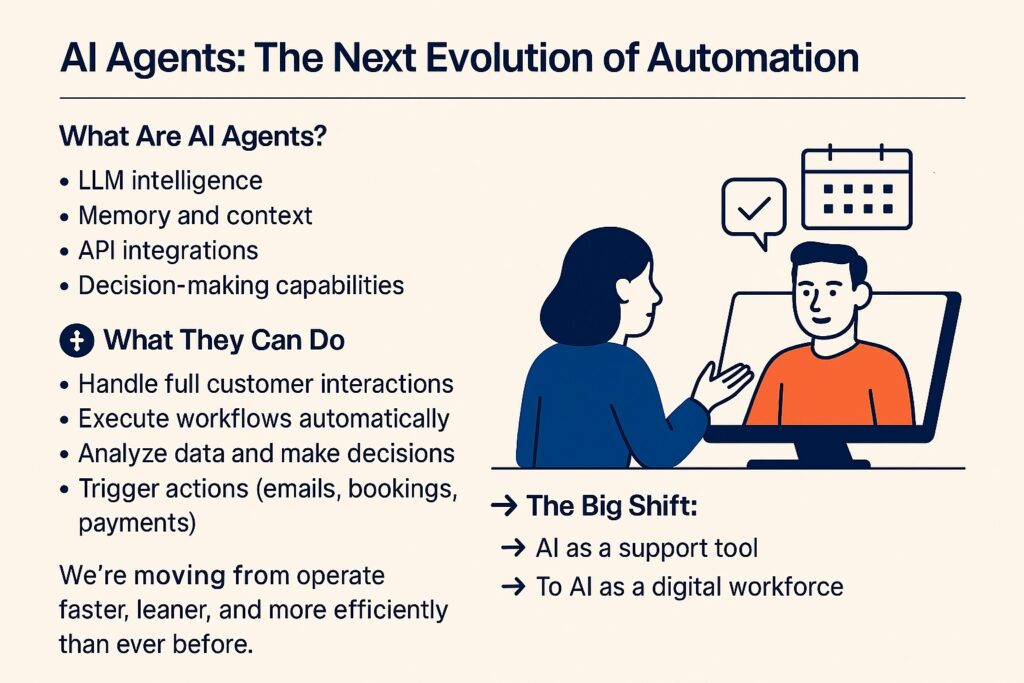
What Are AI Agents?
AI agents are intelligent systems designed to perceive, decide, and act on behalf of a business. They go far beyond scripted automation by combining multiple AI capabilities into a single, goal-oriented entity.
At their core, AI agents combine:
Large Language Model (LLM) Intelligence
LLMs provide reasoning, language understanding, and contextual awareness—allowing agents to interpret complex requests, analyze scenarios, and choose appropriate actions.
Memory & Context
AI agents retain short-term and long-term memory, enabling them to:
- Remember prior customer interactions
- Maintain context across sessions
- Personalize future responses and decisions
API & System Integrations
Agents connect directly to:
- CRMs and ERPs
- Calendars and scheduling tools
- Payment gateways
- Databases and internal software
This enables real-world execution, not just conversation.
Decision-Making Logic
AI agents evaluate data, apply rules, and determine:
- What action to take
- When to escalate to a human
- How to optimize outcomes over time
Together, these components transform AI from a reactive assistant into an autonomous operator.
What AI Agents Can Do in Practice
AI agents excel at managing entire workflows, not isolated tasks.
Full Customer Interaction Handling
Agents can:
- Answer inbound voice or chat inquiries
- Ask qualification questions
- Resolve issues or route intelligently
- Follow up automatically
All while maintaining context and continuity.
Workflow Execution
AI agents orchestrate multi-step workflows such as:
- Lead intake → qualification → CRM updates
- Appointment scheduling → reminders → follow-ups
- Ticket creation → resolution → reporting
Data Analysis & Decision-Making
Agents can:
- Analyze structured and unstructured data
- Detect patterns and anomalies
- Recommend or autonomously execute decisions
Action Triggers
AI agents trigger real-world actions instantly:
- Sending emails or SMS messages
- Booking meetings or site visits
- Processing or requesting payments
Real-World Example: AI Agents in Real Estate
A real estate AI agent demonstrates the true power of autonomy. The agent can:
- Answer inbound phone calls and online inquiries
- Ask qualifying questions (budget, location, timeline)
- Score and prioritize leads automatically
- Schedule property tours on agent calendars
- Send follow-up messages and reminders
The outcome:
- No missed leads
- Faster response times
- Higher close rates
- Less administrative work for human agents
The AI agent functions as a 24/7 virtual real estate assistant, not just a chatbot.
The Big Shift: From Tools to Workforce
We are witnessing a fundamental transition in how businesses use AI:
Before:
AI as a support tool
- Chatbots answering FAQs
- Simple automations with fixed rules
Now:
AI as a digital workforce
- Systems that act independently
- AI handling revenue-generating and operational tasks
- Humans focusing on strategy and high-value decisions
This shift redefines productivity, cost structures, and scalability.
Business Impact of AI Agents
Organizations deploying AI agents achieve:
- Leaner operations with fewer manual touchpoints
- Faster execution across sales, support, and operations
- Lower operational costs without sacrificing quality
- Consistent, always-on service delivery
- Scalable growth without linear headcount increases
AI agents don’t replace teams—they amplify them.
Enterprise-Grade Control & Governance
Modern AI agents are designed with:
- Clear permission boundaries
- Human-in-the-loop overrides
- Security and compliance controls
- Transparent logs and analytics
This ensures autonomy without loss of control.
Final Thoughts: The AI-Driven Future Is Already Here
AI is no longer optional—it is a strategic competitive advantage.
Companies that successfully adopt:
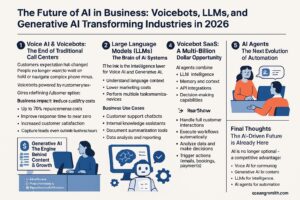
- Voice AI for communication
- Generative AI for content and growth
- LLMs for intelligence
- AI agents for execution and automation
…will operate faster, leaner, and more intelligently than competitors who rely on manual or legacy systems.
AI agents are not the future of work—they are the present reality of high-performing businesses.